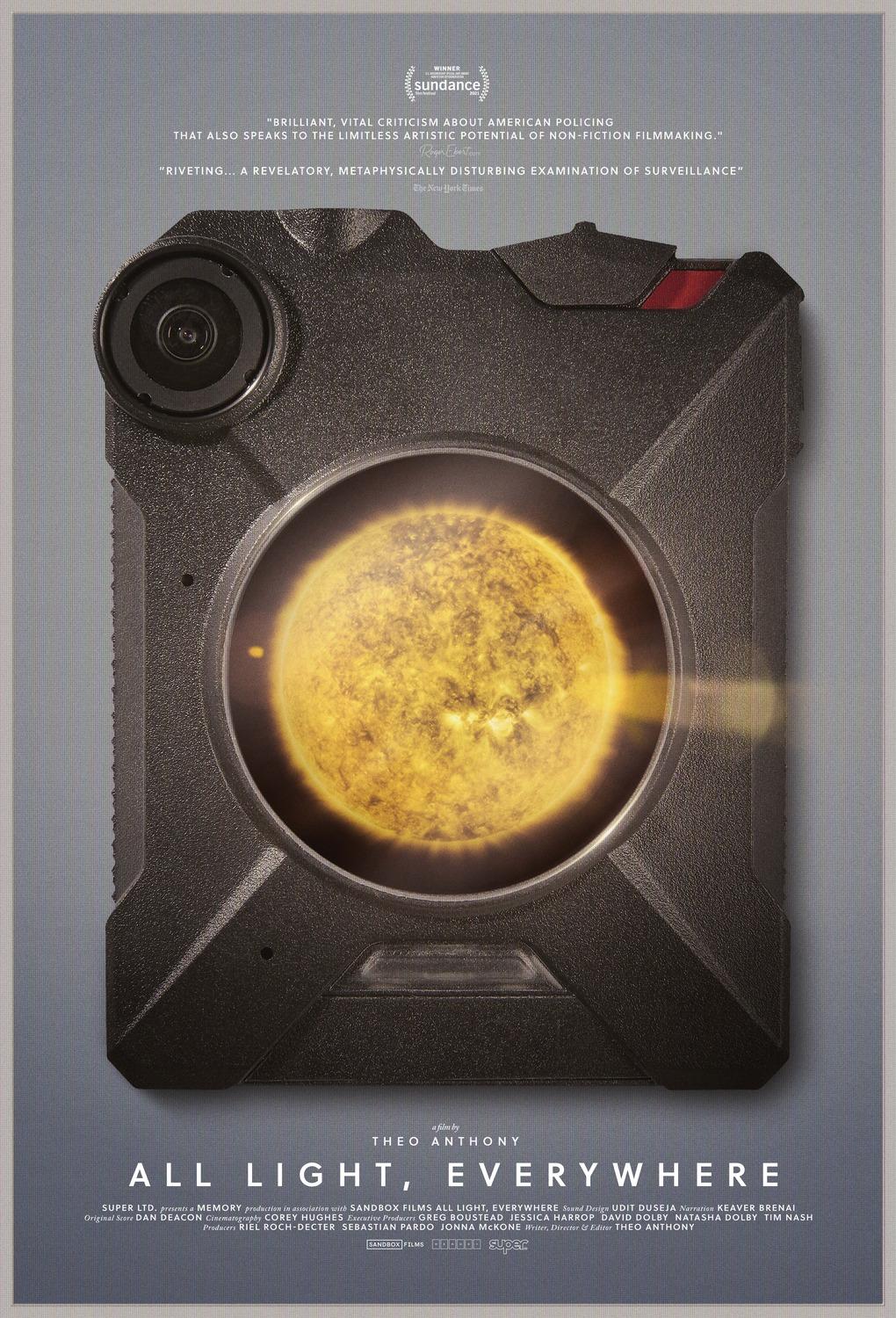
All Light, Everywhere
A far-ranging look at the biases in how we see things, focusing on the use of police body cameras.
Cast
Theo Anthony
Director
Theo Anthony
Self
Keaver Brenai
Self - Narration
Robert Cunniff
Self - Focus Group New York City NY
Ross McNutt
Self - Persistent Surveillance Systems
Steve Tuttle
Self - Axon Enterprise
You Might Also Like
All Light, Everywhere
Rat Film
Addicted to Sexting
Stripped: Las Vegas
Sex Next Door
Life on Our Planet
Body Cam
Stalking Samantha: 13 Years of Terror
Accused: Guilty or Innocent?
Dying for Sex
Our Universe
The BMF Documentary: Blowing Money Fast
Comments
10 Comments
source: All Light, Everywhere
Boring. Audio hurt my ears at certain points. Overall I'm annoyed that I wasted my time watching this. Read some other of the low star reviews for more details about any this was a stinker.
Using big words, quotes, and philosophical takes does not even remotely mean you understand it. It's like it's 2 attempted movies, smushed together; 1 is a walking tour of Axon with actual footage - ok, it's fine, and the second one is a grad school project for liberal arts trying to sound way smarter than it is. Fails miserably on both parts. This film shot for the moon and tripped on its shoe laces while getting dressed instead. Put some actual time and research into a tactile subject. People will like it more than this attempted philosophical jargon that comes off as a movie made by someone who read the title of a book about the subject. Skip this.
From the very beginning, All Light, Everywhere lets you know that it will demand your undivided attention for its entire run time. It's informative, philosophical, and aesthetically pleasing. The story is about cameras, scientific measurement, human sense, and their limitations to discern reality. The story is primarily told through the lens of the modern surveillance state and its application in law enforcement. All Light, Everywhere is unlike a traditional documentary. Approach it as a Sundance award-winning film.
Very messy documentary!!! The subject is all over the place, terrible editing, immature camera work and sound. It looks like a graduate school assignment. Was this a experimental work???
For such a fascinating topic, this "documentary" manages to create 110 minutes of the most uninspired, dull, and pretentious content imaginable. Except for the fascinating excerpts of parts of the history of photography, it tries so hard to be profound, to weave broad narratives, to write an erudite documentary essay, that it just comes across as pompous and dull. There is almost no intelligent commentary or narrative here, or insights. A total and utter waste of time!
Adages such as 'the Observer Changes the Experiment' sum up this insightful reflection on the limitations of perspective. As a camera operator and documentary filmmaker myself, I can say that it is easy to confuse what is captured in the lens with the reality. But the map is not the territory, and the image is not the object in question. Instead, as Theo Anthony's film explains, it is something of a parallax problem -- the position of the observer -- and indeed one's position in authority, as with law enforcement in this film, alters or at least CAN alter what is "seen" in the image. It's just about accountability and openness, but about understanding the position of observation -- making an apt (but admittedly obscure) metaphor with the Transit of Venus -- a textbook case of parallax perspective-shift. Parallax (noun) 2. An apparent displacement of an object observed, due to real displacement of the observer, so that the direction of the former with reference to the latter is changed. Seeing and being seen in an increasingly surveillance- and sousveillance-oriented society cannot account for all the human factors. Bias is built in and hard to strip away. We have a tendency to take things for granted - i.e. "what you see is what you get" -- but the human eye does not take in the real world, and the brain and its functions remain completely isolated from that real world. And thus, symbols are substituted in mental calculations, assumptions driving thinking and decision making.. and the questions of morality, justice, fairness and more are mired in the complex questions surrounding the meta-field of Cybernetics dating back to the 50s. My film "The Minds of Men" (2018) covers similar topics from a totally different perspective. But my interest in the material I have research primed me for the appreciation of Theo Anthony's' fine film. It requires time to digest and think it over, and some audiences don't have energy for that, but a thoughtful viewer will have a lot to walk away with from this rich film.
source: All Light, Everywhere
From the very beginning, All Light, Everywhere lets you know that it will demand your undivided attention for its entire run time. It's informative, philosophical, and aesthetically pleasing. The story is about cameras, scientific measurement, human sense, and their limitations to discern reality. The story is primarily told through the lens of the modern surveillance state and its application in law enforcement. All Light, Everywhere is unlike a traditional documentary. Approach it as a Sundance award-winning film.
Boring. Audio hurt my ears at certain points. Overall I'm annoyed that I wasted my time watching this. Read some other of the low star reviews for more details about any this was a stinker.