Laws of exponents
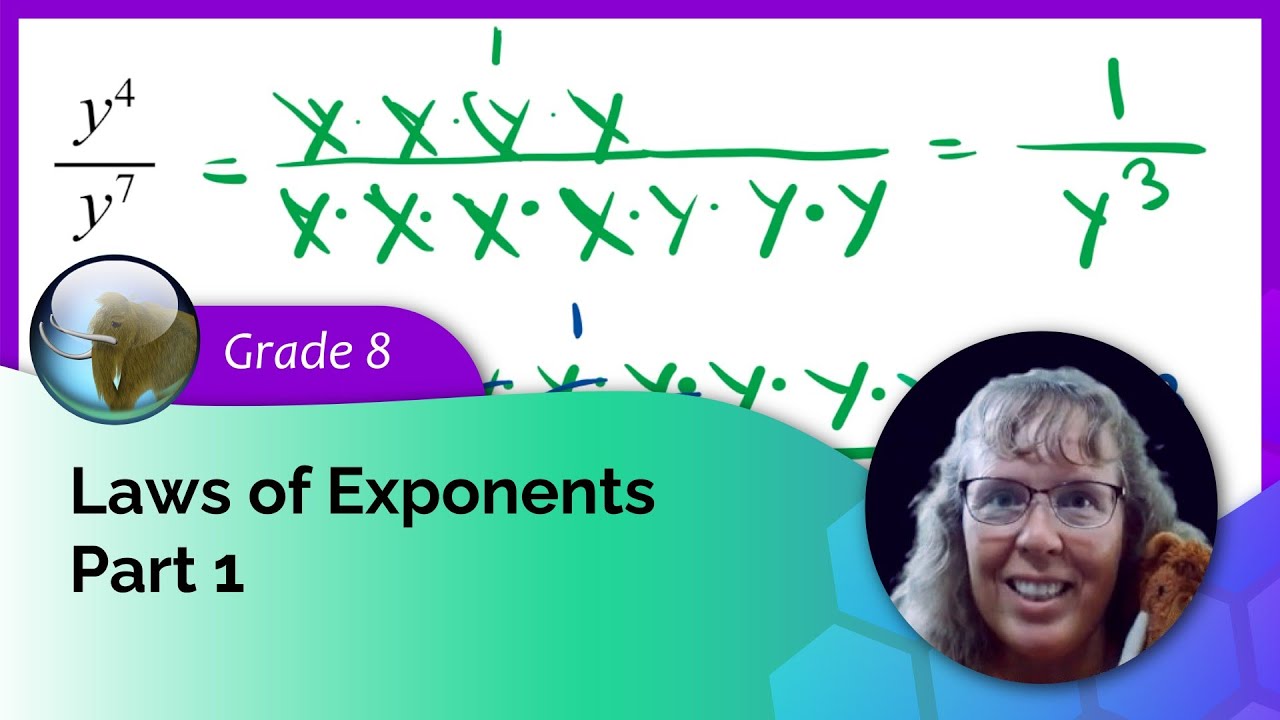
We look at the product and quotient of powers with the same base, e.g. expressions such as a^7(a^4) and x^8/x^5. As a shortcut, in the former situation we can add the exponents, and in the latter, we can subtract them. I also show how to simplify expressions where both exponent laws are useful. Math Mammoth Grade 8 curriculum:
You Might Also Like
Year 10 Math
Maths
Fractions for Kids
Numberblocks - How to Count to Ten | Learn to Count
Numberblocks Fun! | Learn To Count | @Numberblocks
Statistics
Motivational Mondays - FOR STUDENTS!
Numberblocks - The Numbers 1 2 3 | Learn to Count
Numberblocks - MI15 Fact Files
Matholia Singapore Maths - Positions
Matholia Singapore Maths - Angles and Directions
Matholia Singapore Maths - Trapezium
Comments
10 Comments
To write very small numbers (e.g. 0.0000367) in scientific notation, we use ten raised to a negative exponent. For example, 10^(-3) is 1/10^3 or 1/1000, or as a decimal, 0.001. We go through practice problems where we write numbers given in decimal notation in scientific notation and vice versa. I also show how to correct numbers written incorrectly in scientific notation to the correct way. Math Mammoth Grade 8 curriculum:
To write very small numbers (e.g. 0.0000367) in scientific notation, we use ten raised to a negative exponent. For example, 10^(-3) is 1/10^3 or 1/1000, or as a decimal, 0.001. We go through practice problems where we write numbers given in decimal notation in scientific notation and vice versa. I also show how to correct numbers written incorrectly in scientific notation to the correct way. Math Mammoth Grade 8 curriculum:
Here in this second part, I first show an example of ADDING vs. MULTIPLYING two numbers that are written in scientific notation. We will also go through an example where the two numbers have negative exponents. Lastly, we get to space again. I calculate the difference between the diameters of the sun and Jupiter. Then I calculate how many times the sun's diameter is that of Jupiter. Math Mammoth Grade 8 curriculum:
Here in this second part, I first show an example of ADDING vs. MULTIPLYING two numbers that are written in scientific notation. We will also go through an example where the two numbers have negative exponents. Lastly, we get to space again. I calculate the difference between the diameters of the sun and Jupiter. Then I calculate how many times the sun's diameter is that of Jupiter. Math Mammoth Grade 8 curriculum:
First, we find out how many times bigger 6 x 10^5 is than 3 x 10^(-4). This is a multiplicative comparison of two numbers written in scientific notation, which means we divide the numbers to find the answer. Then we compare the mass of the earth with the mass of a person (Alice), and also the mass of Alice with the mass of an ant. The masses are written in scientific notation, and to compare them (a multiplicative comparison), again, we divide the two. Math Mammoth Grade 8 Curriculum
First, we find out how many times bigger 6 x 10^5 is than 3 x 10^(-4). This is a multiplicative comparison of two numbers written in scientific notation, which means we divide the numbers to find the answer. Then we compare the mass of the earth with the mass of a person (Alice), and also the mass of Alice with the mass of an ant. The masses are written in scientific notation, and to compare them (a multiplicative comparison), again, we divide the two. Math Mammoth Grade 8 Curriculum
I explain the basics of significant digits and how to determine how many significant digits or figures a quantity has. Then we look at applications. One is in calculations involving measurements. The final answer is rounded according to the rules of significant digits. Another is measurement conversions. Here, since the conversion factor typically has a lot of significant digits, the measurement itself determines how many sig figures we round the answer to. (In multiplications and divisions, the answer will have as many significant figures as the factor with the least number of significant figures.) Math Mammoth Grade 8 curriculum
I explain the basics of significant digits and how to determine how many significant digits or figures a quantity has. Then we look at applications. One is in calculations involving measurements. The final answer is rounded according to the rules of significant digits. Another is measurement conversions. Here, since the conversion factor typically has a lot of significant digits, the measurement itself determines how many sig figures we round the answer to. (In multiplications and divisions, the answer will have as many significant figures as the factor with the least number of significant figures.) Math Mammoth Grade 8 curriculum
Learn to write large numbers in scientific notation! We look at examples of writing numbers written in scientific notation in normal (decimal) notation, and vice versa. Lastly, I go through some examples where numbers are written incorrectly in scientific notation, and correct those. Math Mammoth Grade 8 curriculum
Learn to write large numbers in scientific notation! We look at examples of writing numbers written in scientific notation in normal (decimal) notation, and vice versa. Lastly, I go through some examples where numbers are written incorrectly in scientific notation, and correct those. Math Mammoth Grade 8 curriculum